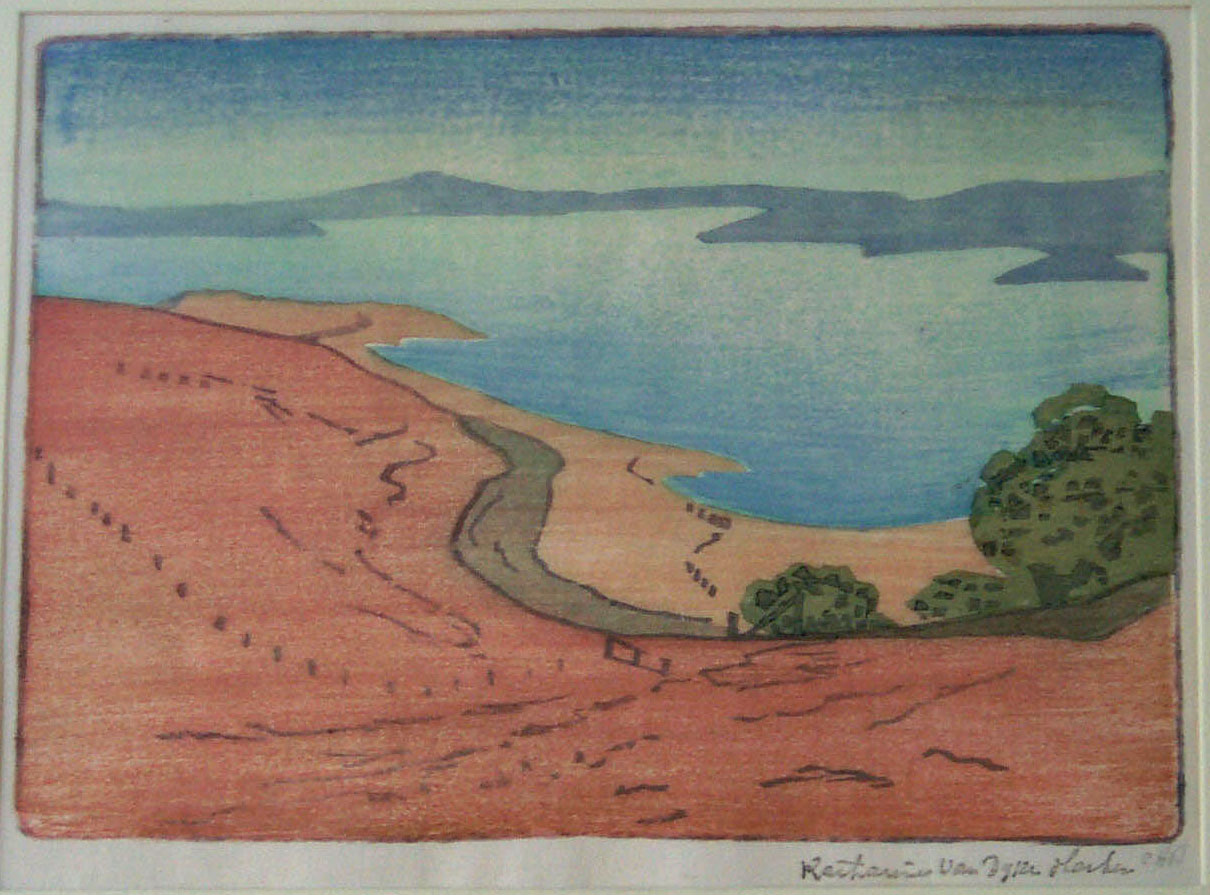
Of all the major printmaking techniques, the color woodcut is one of the most rare. Reasons are no doubt that the difficulty, complexity and time-consuming nature of the technique discourage all but the most dedicated adventurous of artists.
Briefly described, the process of the color woodcut involves the cutting of a design into several blocks, usually one for each color. These blocks are then hand colored with either water-based or oil-based inks made from finely ground powdered pigments and printed onto a sheet of paper in exact registration to insure the greatest accuracy in transfer of the image. Only when all of the blocks have been inked and printed in proper succession is the print finished. American color woodcut artist often took an experimental approach to working in a medium that was essentially new to them.
The first known exhibition of American color woodcuts was at the Boston Museum of Fine Arts in 1895. Color woodcuts began to appear in large group exhibitions as early as 1915 when they were included in the print section of the Panama Pacific International Exposition inn 1915 held in San Francisco. Most of the artists represented were those who were working in Provincetown, Massachusetts. The “Provincetown Printers” dominated several subsequent exhibitions, including one at the Detroit Institute of Arts in 1919. Concurrently, however, there were many artists working in the woodcut medium in other parts of the country, particularly the West Coast. It was not, however, until the Brooklyn Museum exhibition, “American Color Prints” held in the Spring of 1933, that all of these artists were brought together.
Since the 1980s, there has been renewed interest in this art form. The first exhibition of American color woodcuts was, “The Color Woodcut in America, 1895-1945” at the Hearst Gallery at St. Mary’s College in Moraga, California in 1984. Museums have since rediscovered the color woodcut and have begun to include it in its proper place in the graphic arts, largely through increased numbers of exhibitions.
This website is devoted to artists who worked in the woodcut medium showing a diversity of style, technique and artistic interpretation as great as their geographical distance from one another. In no other printmaking medium is the American landscape better portrayed than in the color woodcut. From Provincetown to Pasadena, these prints represent a cross section of color woodblock printing in America during the first half of the 20th century.
 Andrew Terry Keats - Fine Art