Vienna 1900: The Dream and the Reality
The geographic triangle, the boundaries of which were formed by Berlin, Munich, and Vienna, was at the turn-of-the-century, a hotbed of artistic ferment and creativity. Artistic movements in each of these three cultural centers took place separately yet collectively under the common term, Secession.
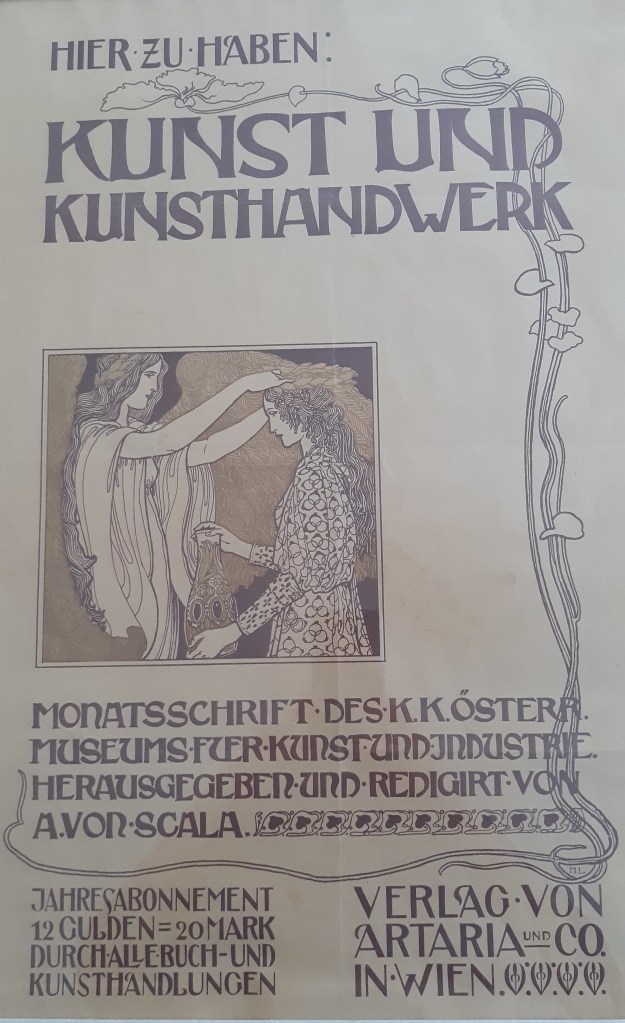
Kunst und Kunsthandwerk, 1898. Heinrich Lefler. Color lithograph poster with gold ink.
There were in fact, three separate and distinct Secession movements, the most well-known being the Vienna Secession which was founded in 1897. Some years earlier, however, in 1892 the Munich Secession began and at about the same time the Berlin Secession had its origins. The Vienna Secession was the last to flourish, but it did so with an intensity and breadth that encompassed and transformed all of the arts.
Der Polster, 1902. Max Kurzweil. Color woodcut.

Secession had its roots in “Art Nouveau” as it was called in France and Belgium, “Style Modern” as it was referred to in Great Britain, and “Jugendstil” as it was known in Austria and Germany. The main currents of new artistic ideas were slow, however, reaching the capital of the Austro-Hungarian Empire, mainly because of its political and cultural position midway between Europe and Asia.
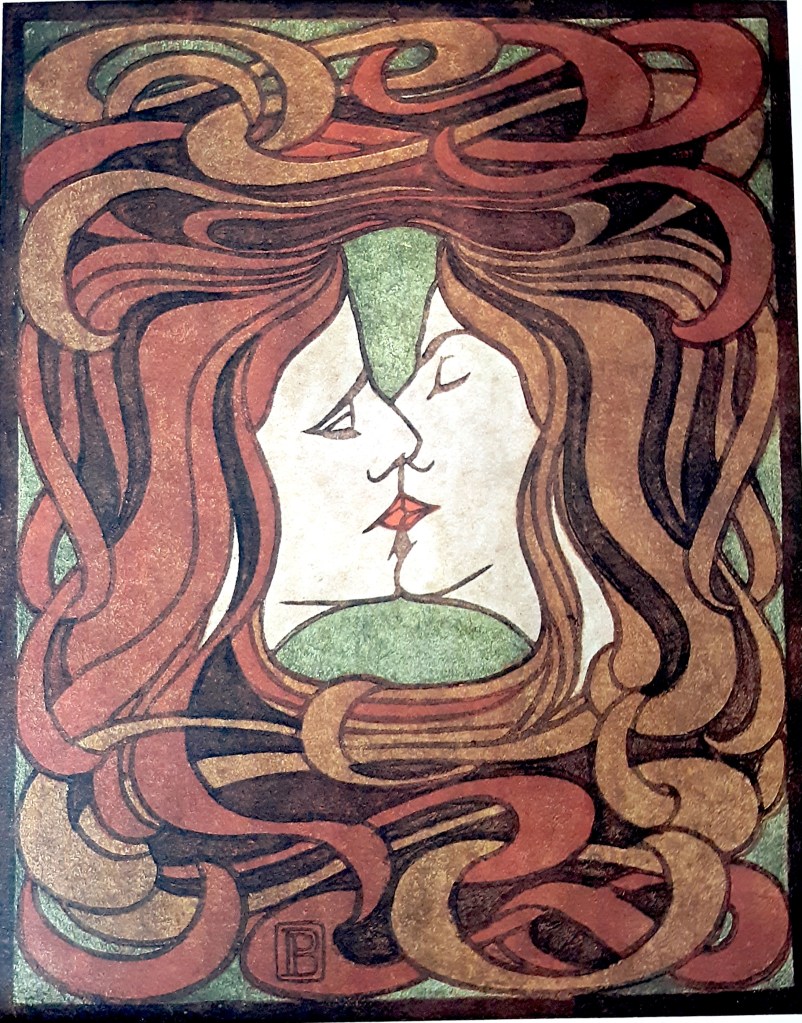
The Kiss, 1897. Peter Behrens, Color woodcut.
Within a very short time however, the Secession succeeded in one of its main objectives – to show the work of a larger number of international artists in order to inspire Austrian art. It is therefore not surprising to see the Secession membership filled with artists of all nationalities, as they were invited to participate in the various Secession exhibitions.
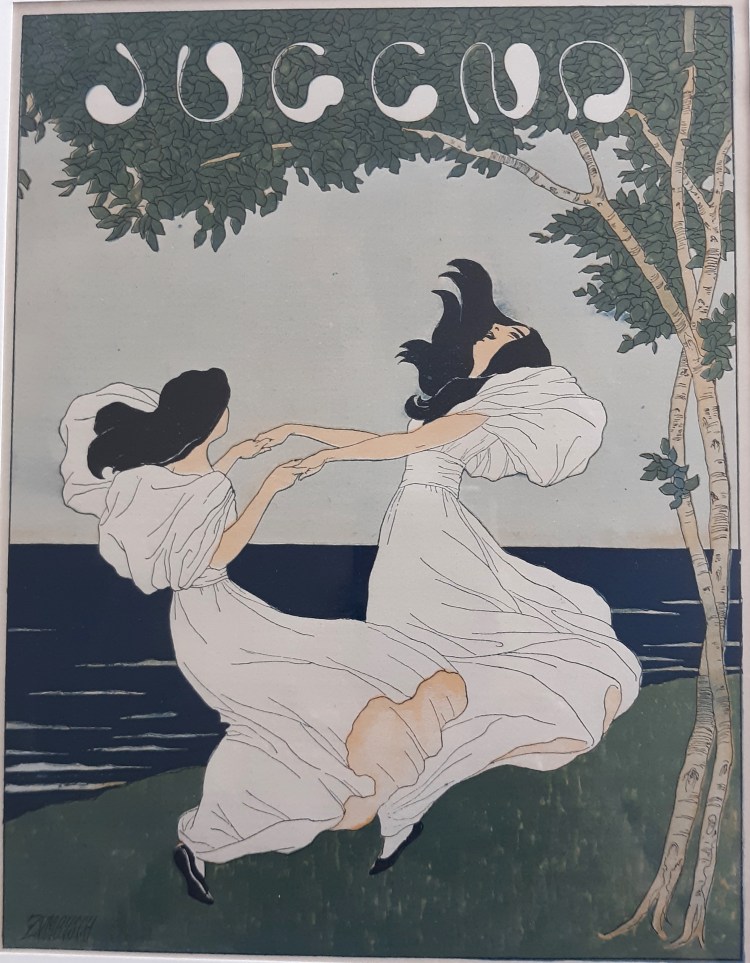
Jugend, 1897. Ludwig von Zumbusch. Color Screen Print. Title page for Jugend Magazine, Heft 40, 1897.
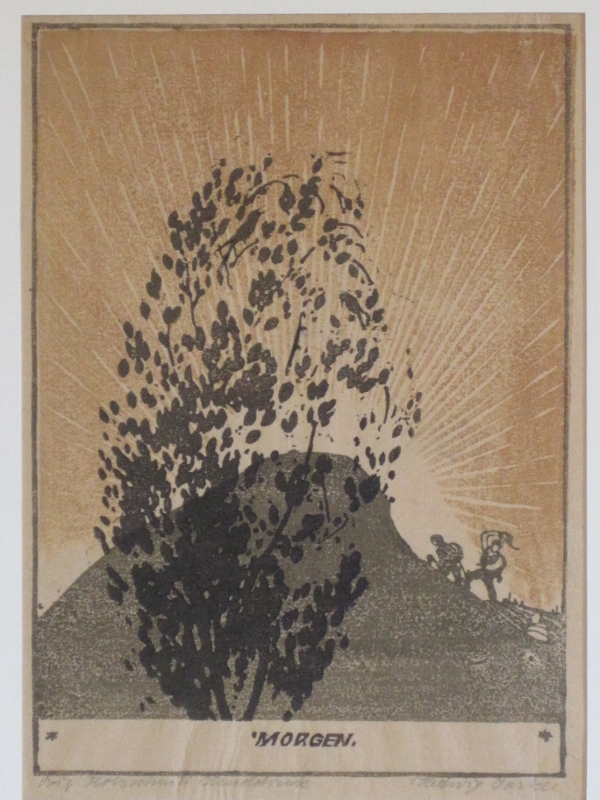
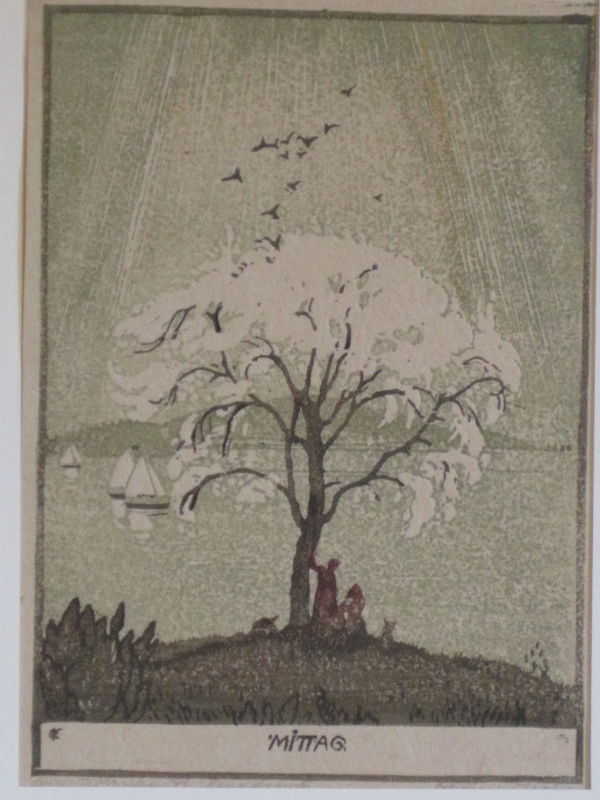
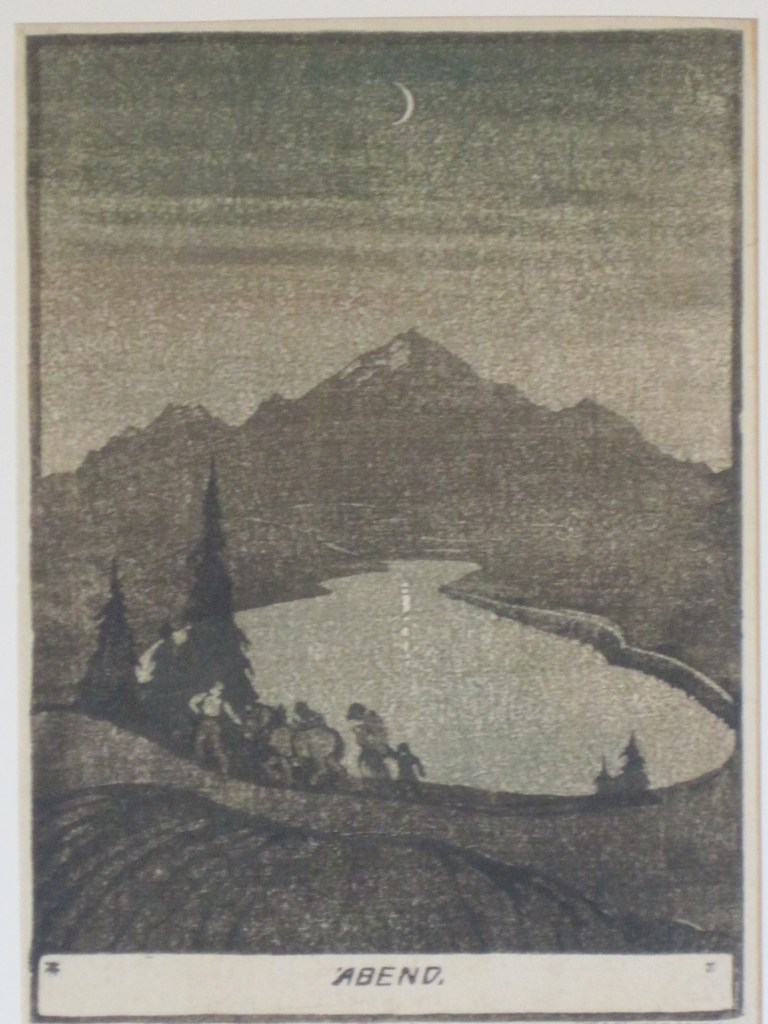
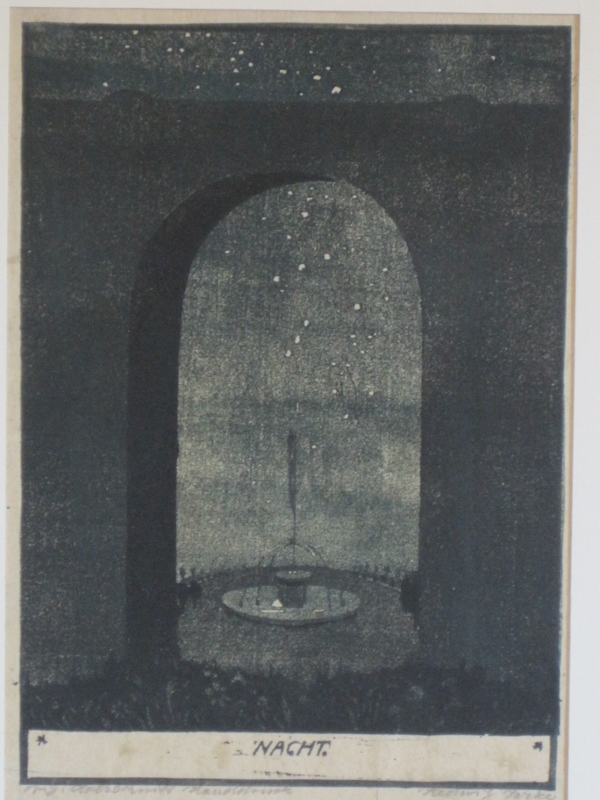
Four times of day: Morgan, Mittag, Abend, Nacht, c.1905. Hedwig Jarke. Color woodcuts.
These graphics were created by artists who lived and worked within this geographic triangle at the turn-of-the-century, as well as those artists who worked in Vienna. Many of these artists knew one another and worked together, and most did exhibit their works in Vienna. The Dream and the Reality is in fact the artistic interpretation of a world soon to be forever changed by the advent of the Great War, the collapse of the Austro-Hungarian Empire, and Vienna’s entry into the twentieth century.
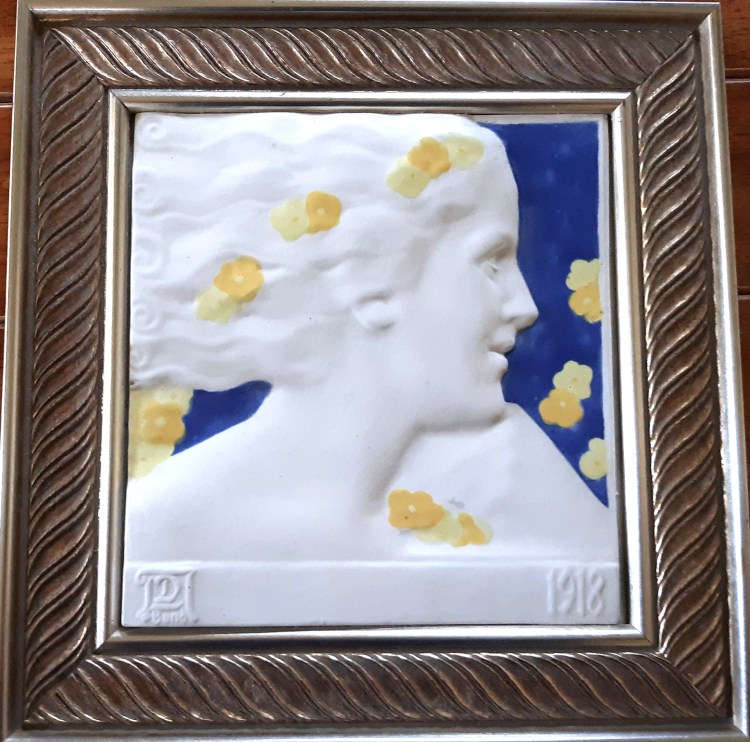
The Jugendstil ceramic tile above, marks the end of the Austro-Hungarian Empire in 1918. The image of a beautiful young woman portrays youth, beauty and hope for the future of Europe.
The tile, made in 1918 at the end of the Great War, was made by the Deutscher Werkbund (German Association of Craftsmen). The Werkbund was founded in 1907 by the architect Joseph Maria Olbrich after he left Vienna for Munich. Amongst the founders was Peter Behrens, whose print, The Kiss, appears above. The Werkbund’s aim was to combine traditional crafts and mass production, and was important in the later development of the Bauhaus school of design.
For a deeper look at Vienna in the year 1900, follow the link below to The Leopold Museum’s (Vienna, Austria) exhibition, Vienna 1900: birth of modernism
https://www.leopoldmuseum.org/en/exhibitions/107/vienna-1900
 Andrew Terry Keats - Fine Art