
Margaret Jordan Patterson, Wind Blown Trees, c.1913. Color woodcut.
Margaret Jordan Patterson (1868-1950), one of the “Provincetown Printers”, was an early student of Arthur Wesley Dow. Her work greatly resembles monotype as she often painted in oil based inks on the blocks; primarily in the soft pastel blues, greens and tans so prevalent in Provincetown where she worked. She exhibited at the Panama-Pacific International Exposition of 1915 in San Francisco, where she won an Honorable Mention.
Bertha Lum, Embankment in Rain, 1908. Color woodcut.
Bertha Lum (1879-1954). Bertha Lum was born in Iowa and studied at the School of The Art Institute of Chicago. After a visit to Japan in 1903, she returned there in 1908 to study the color woodcut technique. Using water-based inks, her work was greatly influenced by Japanese printmaking, and recognized in the Western art world as “Japonisme”.

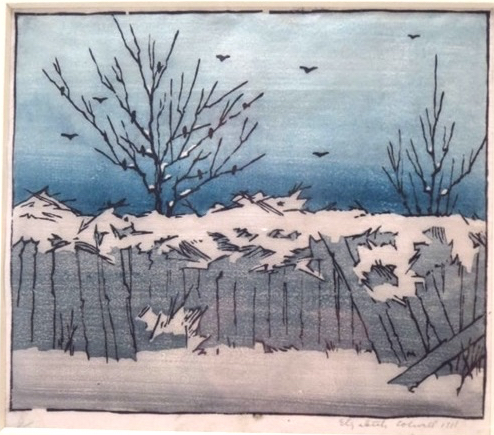
Elizabeth Colwell, Fence in Winter, 1911. Color woodcut.
Elizabeth Colwell (1881-c.1935) was a student of Broor J.O. Nordfeldt at The Art Institute of Chicago. Her earliest prints date from 1908. Her work was also greatly influenced by the Japanese color woodcut. Her delicately applied water based inks lend aa sensitivity and translucence to all of her prints. She to exhibited at the Panama-Pacific Exposition where she won a Bronze Medal.
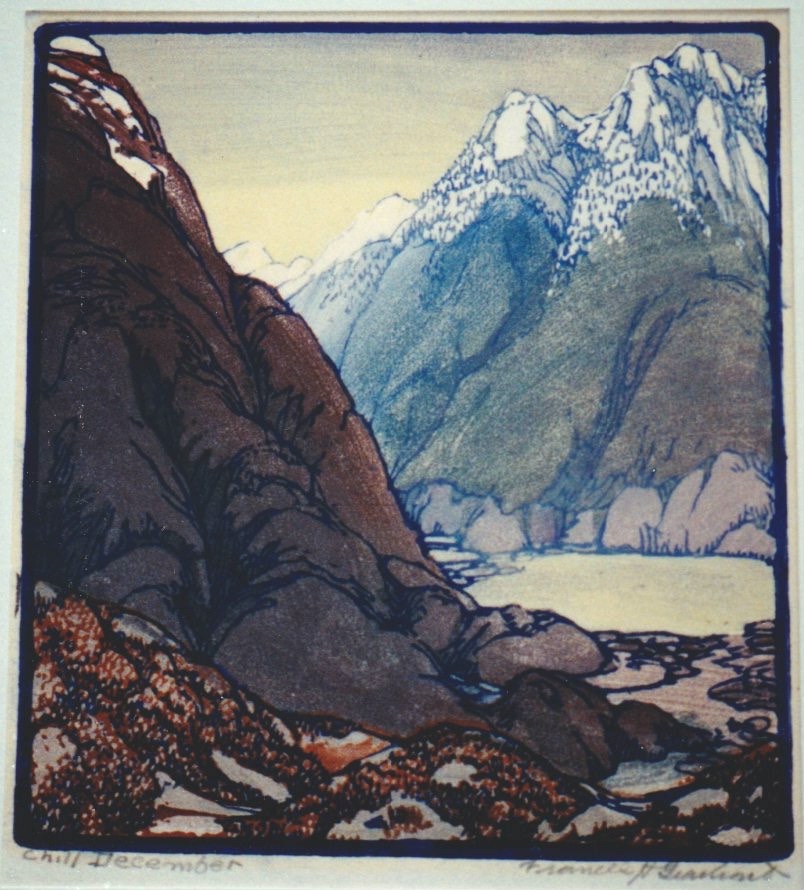
Frances H. Gearhart, Chill December, c. 1930. Color woodcut.
Frances Gerhard (1869-1958) was a self-taught California color woodcut artist. She produced a large body of work and had her first one woman exhibition in 1911. Her woodcuts largely reflect the rugged wilderness of the California coast and high Sierra. Using an oil based ink, her colors are often marked by pure color pigment, which gives her prints a unique vitality. Her studio in Pasadena was the meeting place and exhibition space for many artists, American and European, and she is considered to be a major influence on a number of California woodcut artist who worked after her.
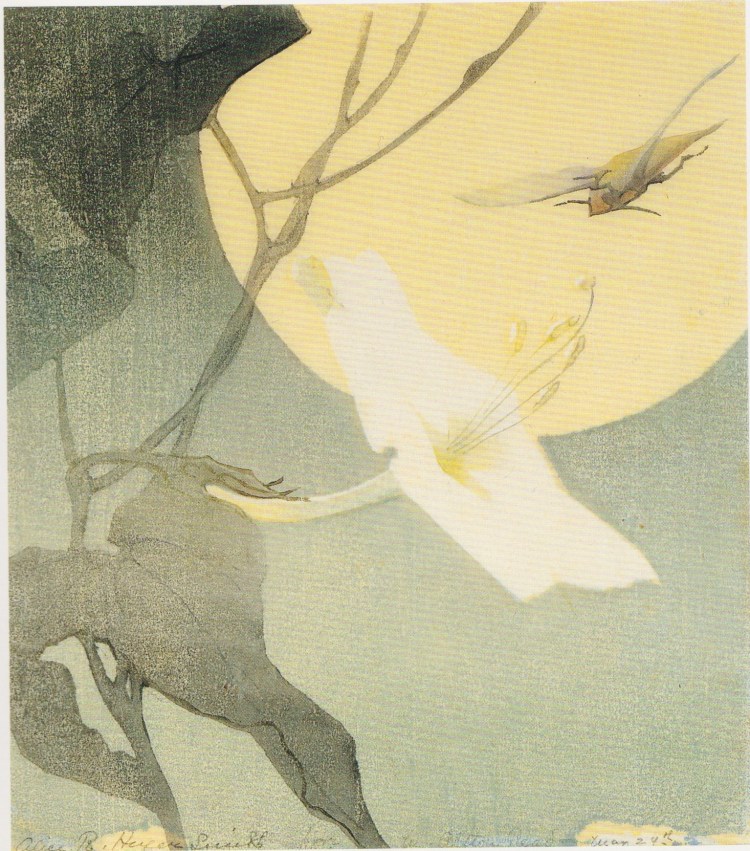
Alice Ravenel Huger Smith, Moon Flower and Hawk Moth, 1918. Color woodcut.
Alice Ravenel Huger Smith (1876-1958) was one of the very few women artists of the Deep South to work in the color woodcut medium. Charleston born and raised, she studied at the school of the Carolina Art Association. She was influenced by a local collection of traditional Japanese color woodblock prints. Smith experimented in this medium, and made only a handful of water-based ink color woodcuts depicting her region. About 1924, she turned her full time attention to watercolor.
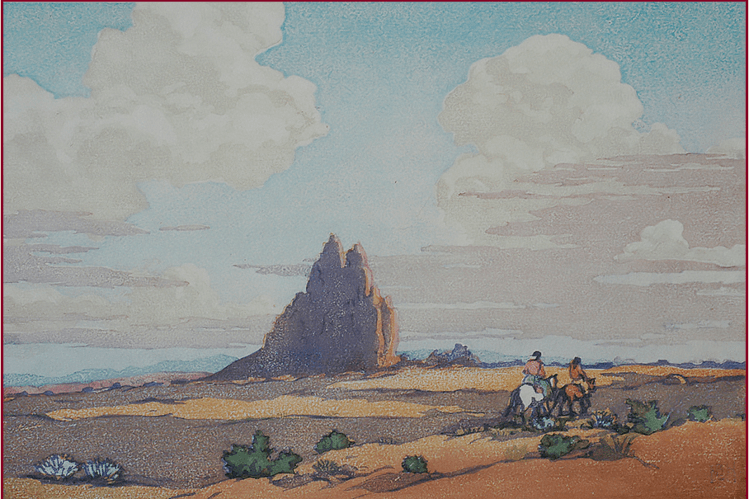
Norma Bassett Hall, Navajo Land, 1947. Color woodcut
Norma Bassett Hall (1889 -1957), the only woman founding member of the Prairie Print Makers, she studied printmaking first on the West Coast, and then at The Art Institute of Chicago. She traveled extensively, and recorded her visits from Britain as well as New England, Kansas, the far West and the Southwest in her prints. Her use of a hard wood, such as cherry, and water-based inks were well suited for the delicate and exacting images of her subject matter.

Katharine Van Dyke Harker, Windswept Oak Tree, c.1928. Color woodcut.
Katharine Van Dyke Harker (1872-1966), was born in San Francisco, studied at the Art Students League, the Hopkins Institute in San Francisco and abroad. She also studied with Frank Morley Fletcher in 1924 in Santa Barbara. Her woodcuts are primarily of landscapes in and around Marin County, California – where she lived all her life. Her use of water-based inks was well suited for her subject matter.
These women among others are now recognized as being largely responsible for bringing the color woodcut to the level of artistic importance that it enjoys today. We are indeed fortunate that a small number of collectors and museums had the foresight to acquire these prints when they did, as the total body produced was not very large and many did not survive the years making them relatively scarce.
 Andrew Terry Keats - Fine Art