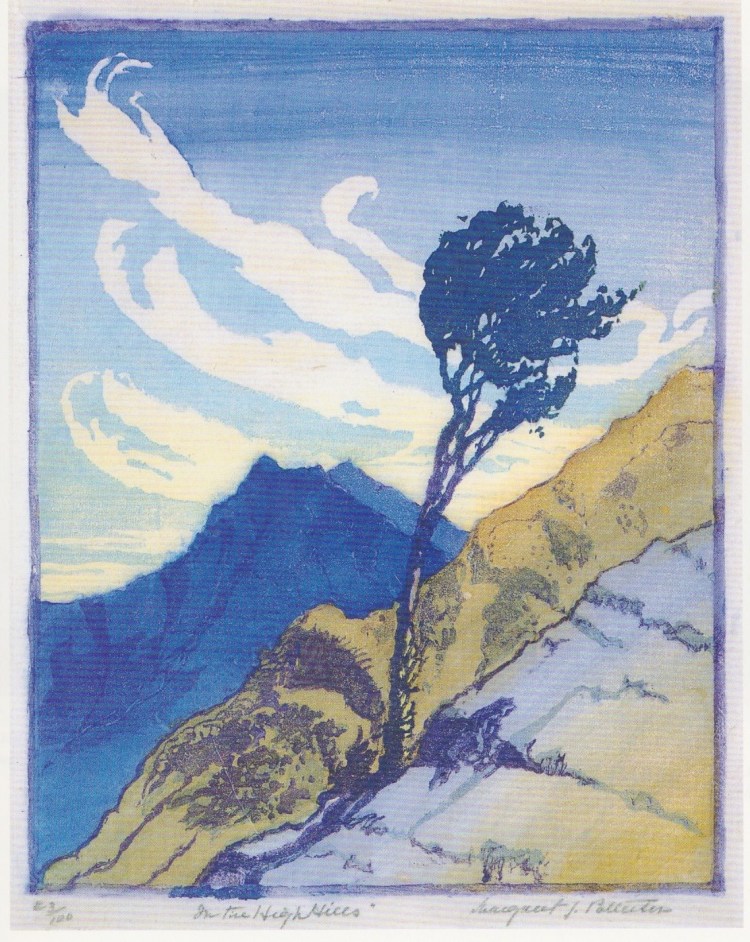
In no other printmaking technique is the woman artist more thoroughly represented than in that of the color woodblock print. In examining the reasons, several seem to surface; some quite apparent, others less so. Perhaps the major appeal and reason that women turned to color woodcuts is that they could easily be made at home. Often the artist worked alone at her own leisure and as time permitted. There was no need for large lithograph and etching presses with the attendant chemicals and acids. All that was needed was a block of wood on which to carve the image to be printed. Of course in the multiple block method, several blocks might be required. Nevertheless this endeavor represented a far less difficult task than other means of printing as these blocks were usually small and therefore easily portable.
For the block printer, a studio was an advantage, even a luxury, but not an absolute necessity. Most artists printed their color woodblock prints by hand. Small hand presses were sometimes used, particularly in the multiple block method, but they were much smaller and less complex than those used in other printmaking techniques.
The tools used were those of the wood carver; various chisels, knives and gouges. Woodblocks, planks, even discarded boards were the medium in which the artist worked. Barens and wooden spoons were used for rubbing the back of the paper against the inked woodblocks when the image was to be printed by hand. The attendant expense was fairly modest (primarily ground color pigments and fine Japanese paper) especially when compared to that of the copper plates, lithographic stones, and the necessary tools for etching and lithography. In short, color woodblock printing represented a direct and comparatively inexpensive method of printmaking.
Woodblock printing was a craft as well as a printmaking medium. Many of the women who carved woodblocks were closely associated with the Arts and Crafts movements. A large number of them were actively involved in art education and taught classes in various parts and crafts at their local schools and colleges as well as in art schools in their communities. It was often an economic necessity that they taught, if only to help provide the means with which to continue and further their printmaking careers. What better way to combine printmaking and arts and crafts than to make color block prints? The very process combines the two distinct disciplines; that of carving and that of printing.
This website brings together women artists who worked in the woodcut medium, showing a diversity of style, technique and artistic interpretation as great as their geographical distances from one another. Included are some of the earliest and most important of the women block printers.
 Andrew Terry Keats - Fine Art